
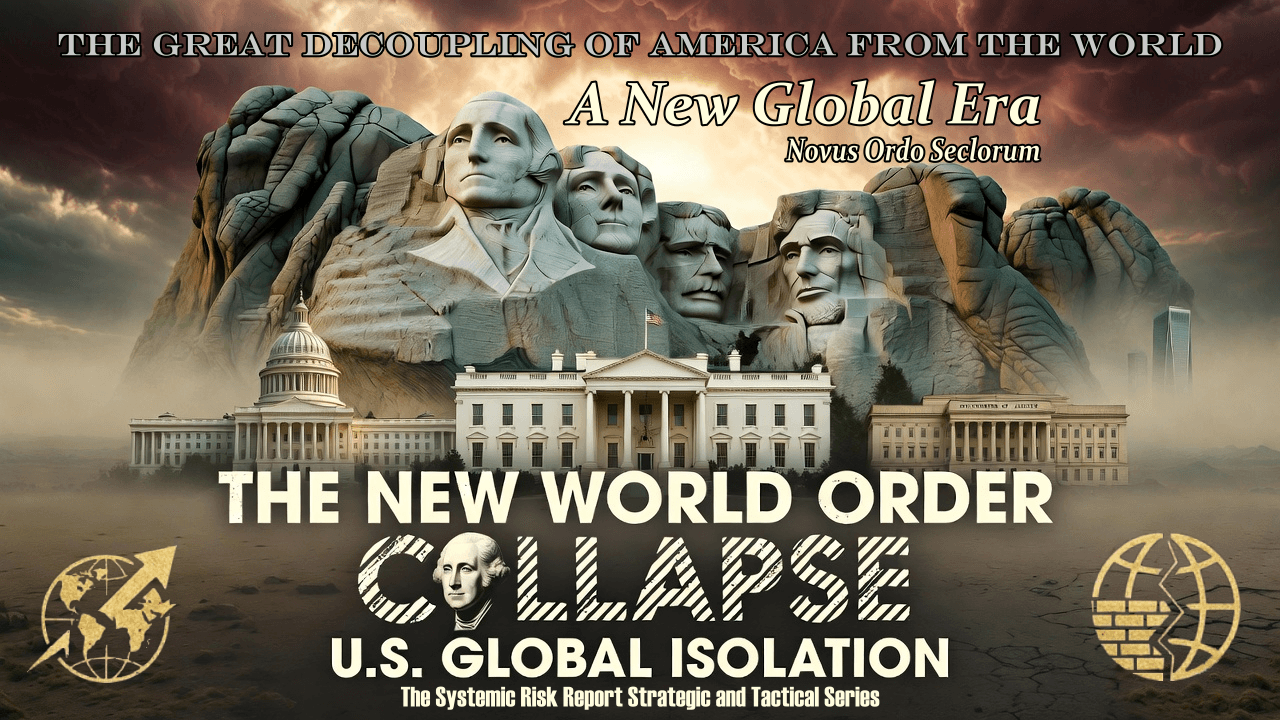
"The New Order of the Ages" examines the macro-financial consequences of the Trump administration's 2025–2026 policy package.
Core Thesis and Structural Shock
The report characterizes the administration's actions—specifically the cancellation of 66 trade agreements, tariff restructuring, and withdrawal from major multilateral institutions—as an exogenous structural shock that has fundamentally altered the global economic order. This shift represents a decisive break from decades of global integration, replacing stability with a regime of high-frequency bilateral volatility.
The Great Reversal: A Structural Shock to Global Order
The report identifies the Trump administration's 2025–2026 policy package—most notably the cancellation of 66 trade agreements and withdrawal from key multilateral institutions (WTO, OECD)—as a profound exogenous shock. This "Great Reversal" represents a decisive break from decades of global integration, replacing stability with a regime of high-frequency bilateral volatility. The document argues that this shift has fundamentally altered the formation of capital, risk premia, and the transmission of monetary policy.
Microeconomic Decay and Financial Repricing
At the microeconomic level, the report observes a distinct pullback in fixed capital expenditure (CapEx) as policy uncertainty acts as a "tax" on forward guidance. Firms are shifting from "just-in-time" efficiency to "just-in-case" resilience, accumulating precautionary inventories that increase working capital requirements and reduce free cash flow.
Asset Valuation: Asset repricing in trade-exposed sectors reflects increased volatility in future cash flows, mechanically elevating the cost of capital and widening credit spreads.
Sovereign Risk: These pressures are spilling over into U.S. sovereign risk, with markets reassessing the long-term competitiveness of the U.S. export base.
Inflationary Pressures and Monetary Constraints
A central thesis of the book is the reconfiguration of inflation dynamics from a low-variance regime to a supply-shock-driven environment.
Sticky Inflation: As supply chains fracture, "sticky" supply-driven inflation has become embedded in core indices.
Central Bank Dilemma: This narrows the Federal Reserve's policy corridor, as supply-driven inflation is harder to neutralize than demand-pull inflation. The report warns of a rising stagflationary risk and increased political scrutiny that threatens central bank independence.
Geopolitical Shocks and Institutional Erosion
The potential U.S. withdrawal from NATO is analyzed as a massive geopolitical shock that increases global risk aversion and weakens the Euro structurally.
Loss of Influence: By withdrawing from multilateral organizations, the U.S. has voluntarily relinquished its strategic advantage in setting global regulatory standards.
Vacuum of Power: In the resulting vacuum, the EU, China, and the BRICS+ coalition are accelerating alternative financial architectures, including non-dollar payment systems and regional liquidity facilities.
Currency Dynamics: The Death of Dominance
The report details a "bifurcation" of the U.S. dollar. While the DXY (Dollar Index) initially strengthened on safe-haven flows, its fundamental support is eroding due to weakened competitiveness and higher production costs.
Dollar Funding Stress: There are early signs of stress in offshore dollar-funding markets, with widening cross-currency basis spreads indicating heightened demand for liquidity amid uncertainty.
Petrodollar Vulnerability: Energy-exporting nations are beginning to diversify settlement currencies to hedge against sanctions and U.S. policy instability.
Market Impacts Across Asset Classes
The document concludes with a data-driven look at market-moving impacts:
Equities: Fragmenting along structural lines, with technology and defense outperforming while manufacturing and agriculture lag.
Bonds: Term premia on long-dated Treasuries have widened as investors demand compensation for geopolitical and fiscal ambiguity.
Commodities: Prices have become more volatile and decoupled from historical anchors.
Final Conclusion
The report warns that the U.S. has entered a "high-variance, supply-shock-driven regime" that constrains policy options and amplifies volatility. Without coordinated monetary, fiscal, and diplomatic responses to restore supply resilience and institutional credibility, macro-financial fragilities will deepen, leading to disruptive, economy-wide episodes.
Login to Publication for a full report.